
When I first walked into a serious weight room in 2007, I was completely overwhelmed. The curved Olympic bars, the intimidating power racks, and the massive iron plates scattered around the chalk-dusted floor made me question if I belonged there at all. Fast forward 15 years, and weightlifting barbell and weights training has transformed not only my physique but my entire approach to fitness and wellness.
I’m Chris Henderson, and after earning my CSCS certification and coaching everyone from grandmothers to competitive powerlifters, I’ve developed a comprehensive understanding of how barbell training can revolutionize anyone’s fitness journey—when done correctly.
In this guide, I’ll share the hard-earned lessons and technical insights I’ve gathered from thousands of coaching sessions to help you navigate the world of barbell training with confidence. Let’s dive in.
The Essentials of Weightlifting Barbell and Weights: Equipment Breakdown
“The difference between a $100 barbell and a $300 barbell wasn’t apparent to me until I tried to deadlift 405 pounds,” Dave, one of my longtime clients, told me after his cheap bar bent permanently during a heavy pull. This expensive lesson highlights a crucial point: understanding your equipment matters.
A standard Olympic barbell weighs 20kg (44lbs) for men and 15kg (33lbs) for women, typically measuring 7.2 feet with varying shaft diameters. But the devil is in the details:
The knurling (the crosshatched grip pattern) varies dramatically between bars—powerlifting bars feature aggressive knurling with center marks for squatting, while Olympic weightlifting bars have smoother knurling with no center marks.
Shaft flexibility (often called “whip”) serves different purposes: competitive Olympic lifters benefit from bars with greater whip that can bend slightly during the pull phase of cleans and snatches, creating a helpful elastic effect. Powerlifters typically prefer stiffer bars that won’t bend during heavy squats.
Sleeve rotation is crucial for Olympic lifts but less important for powerlifting movements. High-quality needle bearings in premium bars allow smoother rotation than the bushings found in mid-range bars.
During my coaching career, I’ve found that most recreational lifters are best served by a versatile, multi-purpose bar with moderate knurling, reasonable whip, and reliable sleeve rotation—what I call the “workhorse bar” that handles everything from bench press to power cleans adequately.
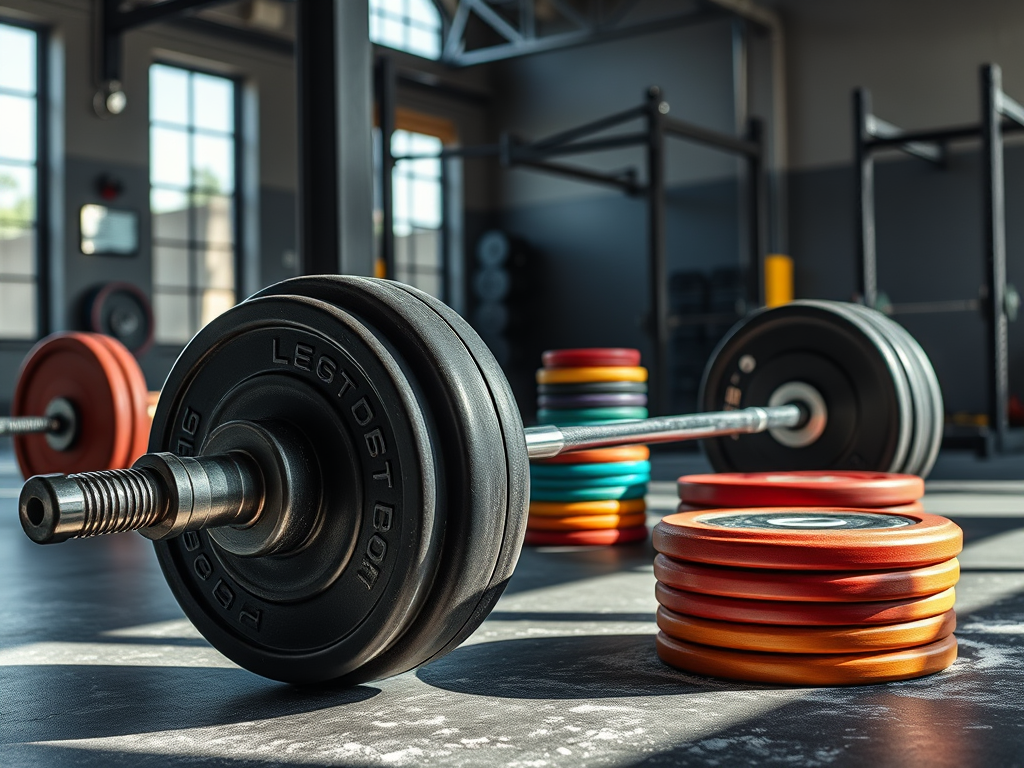
For weight plates, you’ll encounter several varieties:
- Cast iron plates: The traditional option, durable but noisy when dropped
- Bumper plates: Rubber-coated for dropping during Olympic lifts
- Competition plates: Precisely calibrated with standardized diameters
- Change plates: Smaller weights (typically under 5kg) for fine-tuning loads
- Technique plates: Lightweight bumper plates with full diameters for beginners
“I train differently with bumper plates than with iron,” explains Sarah, a 42-year-old client who transitioned from machine-only workouts to barbell training last year. “Knowing I can safely bail on a failed clean attempt by dropping the weight gives me confidence to push harder.”
GROUND-BREAKING WEIGHT LOSS SOLUTION!🔥 Trigger your body’s natural slimming mechanism with a secret celebrities have been hiding! 💪


The Scientific Benefits of Weightlifting Barbell and Weights
When I transitioned from machine-based training to barbell work in my late twenties, the difference was remarkable. Within months, my chronic shoulder pain disappeared, my resting heart rate dropped, and I developed practical strength that transferred directly to moving furniture and carrying groceries—real-world tasks that seemed disconnected from my previous gym efforts.
The research supports these anecdotal benefits. A landmark 2010 study published in the Journal of Strength and Conditioning Research found that free weight exercises activated 43% more muscle fibers than machine-based counterparts. This increased neural recruitment explains why barbell training produces such effective strength gains.
Other evidence-backed benefits include:
- Enhanced hormone response: A 2018 meta-analysis found that compound barbell movements triggered significantly higher testosterone and growth hormone release compared to isolation exercises.
- Greater bone density improvement: Research from the University of Missouri demonstrated 2-3% increases in bone mineral density after 24 weeks of progressive barbell training in middle-aged adults.
- Superior metabolic impact: Heavy compound movements can elevate post-exercise oxygen consumption (EPOC) for up to 38 hours, burning additional calories long after your workout ends.
- Improved neuromuscular coordination: Free weight training enhances proprioception and motor unit recruitment patterns that transfer directly to daily activities.
Dr. Andrew Galpin, Professor of Kinesiology at Cal State Fullerton, summarizes it well: “Machine training produces isolated adaptations, while barbell training produces integrated, functional adaptations. Your body doesn’t recognize individual muscles—it recognizes movement patterns.”
Mastering Fundamental Barbell Movements Through Technical Precision
After observing thousands of lifters, I’ve found that technical mastery—not just raw strength—separates successful trainees from those who plateau or get injured. Let’s break down the key technical elements of foundational movements.
The Squat: Building Your Foundation
The barbell squat might look simple, but it contains numerous technical subtleties that took me years to fully understand as a coach. The difference between a mediocre squat and an excellent squat often comes down to:
- Bar placement: High-bar position (across upper traps) creates a more upright torso angle ideal for Olympic lifters and those with good ankle mobility. Low-bar position (across posterior deltoids) allows for greater loading potential by increasing hip involvement.
- Breathing mechanics: The Valsalva maneuver—taking a deep breath and holding it while bracing your core—creates intra-abdominal pressure that stabilizes your spine. I teach clients to “breathe into their belt” rather than their chest.
- Foot pressure: Elite lifters maintain pressure through the “tripod” of the foot—big toe, little toe, and heel—rather than shifting to the toes or heels during the movement.
- Knee tracking: Contrary to outdated advice, the knees should track in line with the toes, which often means they’ll move past the toes for most lifters with average proportions.
- Torso angle: Your torso angle should remain constant throughout the lift—neither collapsing forward during the ascent nor hyperextending at the top.
I spent six months correcting client Tom’s squat technique before adding serious weight to the bar. “I was frustrated at first,” he admits, “but once we fixed my knee cave and forward lean issues, my squat skyrocketed from 225 to 315 in just eight weeks—with zero pain.”
The Deadlift: Harnessing Total Body Power
The deadlift remains my favorite barbell exercise for its simplicity and effectiveness. After coaching hundreds of clients through proper deadlift mechanics, I’ve distilled the movement to these critical components:
- Setup positioning: The bar should start over mid-foot (not the toes), with shoulders slightly ahead of the bar and hips higher than knees but lower than shoulders.
- The wedge technique: Elite powerlifters “pull the slack out” of the bar before initiating the lift, creating tension throughout the posterior chain before the weight leaves the ground.
- Bar path: A proper deadlift maintains a vertical bar path directly over mid-foot throughout the entire range of motion.
- Hip hinge mechanics: The deadlift is primarily a hip extension movement, not a squat. The hips and shoulders should rise at the same rate until the bar passes the knees.
- Lockout execution: Finishing the lift requires glute activation to bring the hips through, not hyperextension of the lower back.
Professional strongman competitor and my occasional training partner Marcus Walsh puts it simply: “The deadlift rewards patience off the floor. Most people rush the first pull and then get stuck at mid-shin. Stay tight, be patient, and the weight will move.”

The Bench Press: Technical Nuances Beyond the Basics
While seemingly straightforward, the bench press becomes infinitely more effective when incorporating these technical elements I’ve refined through years of coaching:
- Scapular positioning: Retracting and depressing the shoulder blades creates a stable platform and reduces shoulder strain.
- Leg drive: Properly utilizing leg drive transfers force through a rigid torso to increase pressing power without changing bar path.
- Bar path optimization: Research from the International Journal of Sports Physiology and Performance confirms that elite bench pressers use a slightly curved bar path rather than a perfectly vertical one.
- Grip considerations: Grip width affects muscle activation patterns significantly—wider grips increase pectoral involvement while narrower grips emphasize triceps.
- Elbow tuck angle: Most recreational lifters allow their elbows to flare excessively. A moderate tuck (approximately 45-60 degrees relative to the torso) maximizes force production while minimizing shoulder stress.
My client Maria increased her bench press by 35% in three months not by training more frequently but by implementing these technical refinements with weightlifting barbell and weights. “I’d been bench pressing for years,” she said, “but never understood how important setup and leg drive were until we fixed those elements.”

Structured Programming: Beyond Random Training
After designing hundreds of barbell programs, I’ve found that effective training isn’t about finding the “perfect” exercises—it’s about organizing work systematically to create progressive overload while allowing adequate recovery.
Here’s a framework I’ve successfully used with intermediate lifters:
Four-Day Upper/Lower Split:
Monday – Lower Body Strength
- Back Squat: 5 sets of 3 reps at 85% 1RM (2-3 min rest)
- Romanian Deadlift: 3 sets of 8 reps at 70% (90 sec rest)
- Bulgarian Split Squat: 3 sets of 10 reps per leg (60 sec rest)
- Weighted Planks: 4 sets of 30 seconds (45 sec rest)
Tuesday – Upper Body Strength
- Bench Press: 5 sets of 3 reps at 85% 1RM (2-3 min rest)
- Weighted Pull-ups: 4 sets of 6 reps (2 min rest)
- Overhead Press: 3 sets of 8 reps at 70% (90 sec rest)
- Face Pulls: 3 sets of 15 reps (60 sec rest)
Thursday – Lower Body Volume
- Deadlift: 3 sets of 5 reps at 80% 1RM (3 min rest)
- Front Squat: 3 sets of 8 reps at 70% (2 min rest)
- Walking Lunges: 3 sets of 24 steps total (90 sec rest)
- Hanging Leg Raises: 3 sets of 12 reps (60 sec rest)
Friday – Upper Body Volume
- Incline Bench Press: 3 sets of 8 reps at 75% (2 min rest)
- Barbell Rows: 4 sets of 10 reps at 70% (90 sec rest)
- Push Press: 3 sets of 6 reps at 75% (2 min rest)
- Superset: Bicep Curls and Tricep Extensions: 3 sets of 12 each (45 sec rest)
The effectiveness of this structure lies in its alternation between strength-focused and volume-focused days, strategic exercise selection, and carefully planned intensity parameters.
“The biggest mistake I see recreational lifters make is program hopping,” notes Dr. Mike Israetel, sports physiologist and founder of Renaissance Periodization. “They never stick with a protocol long enough to drive adaptation before moving to the next shiny program.”
I’ve observed this same pattern. Clients who commit to a structured program for 12+ weeks consistently outperform those who change routines monthly, regardless of the specific protocol they follow.

Equipment Considerations for Building Your Iron Paradise
When the pandemic forced my clients to train at home, I helped dozens of them establish effective home gyms. Here’s what I learned about essential equipment investments:
- The barbell matters more than you think: A quality barbell from Rogue, Texas Power Bars, or Rep Fitness costs $250-400 but will last decades. Economy bars under $150 typically use inferior steel that can permanently bend under heavy loads.
- Plate priorities: Start with a pair each of 45s, 25s, 10s, 5s, and 2.5s before expanding your collection. If Olympic lifts are in your program, invest in bumper plates.
- Rack considerations: A power rack with safety pins is non-negotiable for solo training. The ability to fail safely on squats and bench press removes a major limitation of home training.
- Flooring solutions: Horse stall mats from agricultural supply stores provide excellent durability at roughly $2/sqft compared to specialized gym flooring at $5-10/sqft.
- Bench requirements: A sturdy flat bench with a 1,000lb+ weight capacity is essential. Adjustable benches offer versatility but typically have lower weight ratings.
My client James built a complete home gym during the pandemic for under $1,500 that rivals commercial facilities for his specific needs. “The key was prioritizing the essentials you recommended rather than buying everything at once,” he explained. “Quality barbell, power rack, bench, and plates first—accessories later.”
Nutrition and Recovery: The Foundation of Progress
The most perfectly designed training program will fail without adequate recovery systems. After seeing hundreds of plateaued lifters revitalize their progress through improved recovery strategies, I’ve identified these critical factors:
- Protein timing and distribution: Research from the American Journal of Clinical Nutrition suggests that distributing protein intake evenly throughout the day (25-40g per meal) optimizes muscle protein synthesis better than consuming the same total protein in uneven amounts.
- Sleep quality interventions: Studies consistently show that sleep deprivation reduces testosterone production, increases cortisol, and impairs motor learning—all devastating to strength progress. Concrete strategies like establishing consistent sleep/wake times and eliminating blue light exposure 90 minutes before bed have helped my clients add 20-30% to their main lifts within months.
- Strategic deloading: Incorporating planned reduced-volume weeks every 4-8 weeks depending on training intensity prevents overtraining and allows supercompensation.
- Mobility maintenance: Daily movement preparation focused on thoracic extension, hip internal rotation, and ankle dorsiflexion directly improves technical execution of primary barbell movements.
- Stress management protocols: Techniques like diaphragmatic breathing, nature exposure, and meditation measurably reduce cortisol levels that otherwise impair recovery.
Former competitive powerlifter and nutrition specialist Dr. Layne Norton emphasizes, “Recovery isn’t passive—it’s an active process that requires as much attention as your training sessions themselves.”
Conclusion: The Transformative Impact of Barbell Training
After 15 years of coaching and personal experience with weightlifting barbell and weights, I’ve seen firsthand how this type of training transforms not just physiques but lives. The methodical progression, measurable results, and functional carryover to daily activities create a uniquely satisfying fitness experience.
But perhaps the most powerful aspect of barbell training is its objectivity. As strength coach Mark Rippetoe famously states, “The barbell is the most honest training partner you’ll ever have—it doesn’t care about your excuses, only your execution.”
Remember that strength development is a marathon, not a sprint. Focus on technical mastery before pursuing maximum loads, respect recovery as much as training itself, and approach each session with purposeful intent rather than ego.
Whether your goals involve competitive strength sports, improved body composition, enhanced athletic performance, or simply aging gracefully with functional independence, a well-designed barbell program offers the most efficient path to physical capability I’ve encountered in my career.
The iron never lies—put in the consistent, technically sound work, and your results will speak for themselves.
WANT TO ELIMINATE STUBBORN BELLY FAT QUICKLY? 🔥Here’s your ultimate solution! Add this flavorless powder to your morning coffee and see the incredible transformation! 💪





 Simple Steps to Smarter Eating & Weight Loss
Leave a comment